
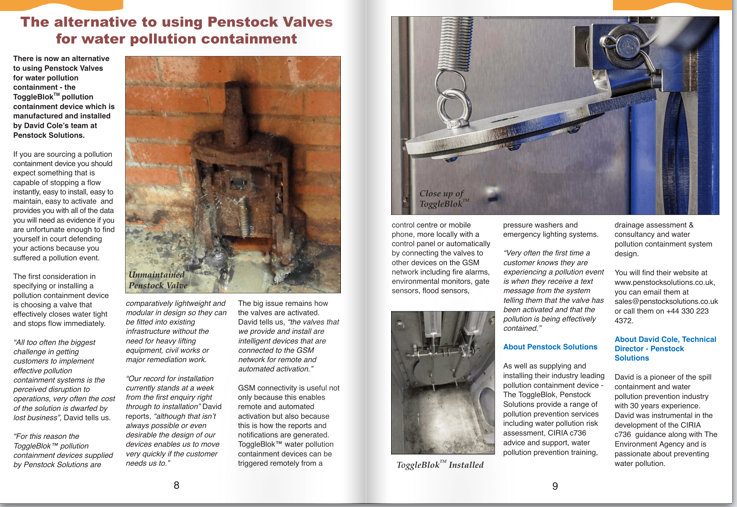
For many years, penstock valves have been widely used as a method of controlling flow within drainage systems. However, as environmental risks and regulatory expectations evolve, there is increasing demand for faster, more reliable pollution containment solutions.
Today, automated containment systems such as ToggleBlok® are providing a modern alternative — designed specifically to address the limitations of traditional approaches.
Rethinking Pollution Containment Requirements
When specifying a pollution containment system, operators should expect more than just a method of restricting flow.
A suitable solution should:
- Stop flow immediately and reliably
- Operate without reliance on manual intervention
- Be simple to install and maintain
- Provide clear operational data and auditability
- Perform under real emergency conditions
This is particularly important where sites face risks from firewater, chemical spills, or contaminated surface runoff.
In these scenarios, response time is critical — and any delay can result in pollutants leaving the site boundary.
The Limitations of Traditional Penstock Valves
While penstock valves remain widely used, they were not originally designed as dedicated pollution containment systems.
Common challenges include:
- Dependence on manual activation
- Slower response times during incidents
- Potential leakage under real-world conditions
- Installation complexity and disruption
- Limited integration with modern monitoring systems
These limitations can become significant when dealing with fast-moving or high-risk events.
A Modern Alternative: Automated Containment
Systems such as ToggleBlok® have been developed specifically to overcome these challenges.
Rather than relying on manual operation, automated containment valves are designed to respond instantly when triggered — isolating drainage systems before contamination can spread.
Key characteristics include:
- Rapid closure (typically within seconds)
- Integration with fire alarms, sensors, and monitoring systems
- Remote and automatic activation capability
- Stand-alone operation independent of mains power
- Modular design enabling retrofit into existing infrastructure
This approach allows containment to occur even if personnel are not present or systems are compromised.
Minimising Installation Disruption
One of the most common concerns when upgrading containment systems is disruption to operations.
Modern containment solutions address this through:
- Lightweight, modular construction
- Installation within existing drainage systems
- Reduced need for major civil works
- Faster deployment times compared to traditional systems
In many cases, systems can be installed with minimal interruption — making it easier for sites to upgrade protection without impacting productivity.
Intelligent Activation and Monitoring
A critical advantage of automated systems is how they are activated and managed.
Modern containment valves can be:
- Triggered automatically by fire alarms or environmental sensors
- Activated remotely via control systems or mobile devices
- Monitored in real time, providing status updates and alerts
In some cases, operators are first alerted to an incident by the system itself — confirming that containment has already been deployed.
This not only improves response but also provides valuable audit data and compliance evidence.
Supporting Compliance and Risk Reduction
As guidance such as CIRIA C736 highlights, containment systems must be reliable, repeatable, and capable of operating under emergency conditions.
For operators, this means moving beyond systems that rely on manual intervention and toward solutions that can be trusted to perform automatically.
By adopting modern containment approaches, sites can:
- Reduce the risk of environmental incidents
- Improve compliance with regulatory expectations
- Minimise potential liability and clean-up costs
- Demonstrate proactive environmental management
Reviewing Your Current Approach
For many organisations, the question is no longer whether containment is required — but whether existing systems are sufficient.
Key considerations include:
- How quickly can your system isolate drainage?
- Does it rely on human intervention?
- Will it function during power or system failure?
- Can it provide evidence of performance during an incident?
Exploring Alternatives to Penstock Valves
As environmental risks continue to evolve, so too must the systems designed to manage them.
Automated containment solutions such as ToggleBlok® offer a practical alternative — combining speed, reliability, and integration with modern site infrastructure.
For operators, consultants, and engineers, this represents an opportunity to move beyond traditional limitations and adopt a more robust approach to pollution prevention.